Digital Signage for Supermarkets: Smart Display Solutions for Every Store Area
Modern supermarkets are no longer just places to buy groceries. They are becoming more interactive retail environments where product discovery, promotional advertising, customer service, and brand communication all play an important role.
Traditional posters and printed promotional materials still have their place, but digital signage offers retailers more flexibility. From wall-mounted advertising players at store entrances to countertop displays at checkout areas, digital screens can help supermarkets communicate with shoppers throughout their shopping journey.
Digital signage for supermarkets is not limited to large advertising screens or shelf-edge displays. Different display formats can serve different purposes, including product promotion, digital menu boards, customer reviews, interactive information, and brand advertising.
For supermarket chains, retail technology providers, and digital signage integrators, choosing the right combination of displays can create a more consistent and engaging in-store experience.
In this guide, we explore the most useful digital signage solutions for supermarkets and explain how different display types can be applied across a retail environment.
1. What Is Digital Signage for Supermarkets?
Digital signage for supermarkets refers to electronic displays used to present advertising, product information, promotional campaigns, and customer-facing content in grocery stores and retail environments.
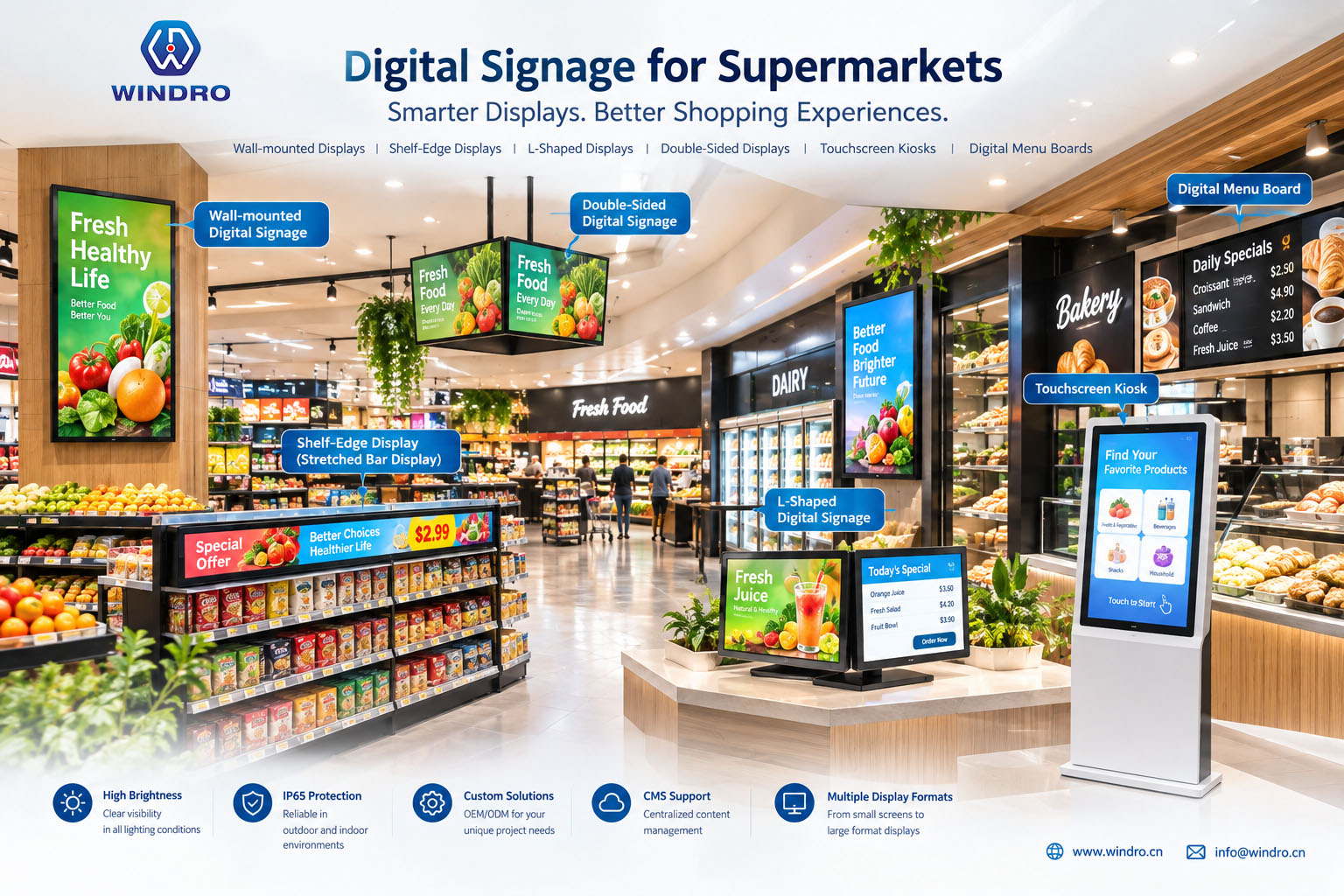
Depending on the location and business requirements, a supermarket may use several types of digital signage:
- Wall-mounted digital signage displays
- Countertop and desktop advertising players
- L-shaped digital signage displays
- Double-sided hanging advertising screens
- Large-format commercial displays
- Touchscreen information displays
- Digital menu boards for bakery, deli, and food service areas
- Stretched bar displays for shelf-edge advertising
Each format serves a different purpose. A wall-mounted screen can promote weekly offers, while a compact desktop advertising player can communicate with customers at a service counter.
The most effective solution is not necessarily the one with the largest screen. It is the one that fits the available space, viewing distance, content requirements, and customer interaction.
2. Wall-Mounted Digital Signage for Supermarket Advertising
Wall-mounted digital signage is one of the most versatile display formats for supermarkets. It can be installed near entrances, above promotional areas, along shopping aisles, or behind service counters.
These displays are suitable for presenting promotional videos, product images, seasonal campaigns, brand messages, and store announcements.
Where Can Wall-Mounted Advertising Displays Be Used?
Store entrances: Welcome shoppers and highlight weekly promotions, new products, or membership benefits.
Shopping aisles: Promote featured products and communicate category-specific offers.
Checkout areas: Display impulse-buy promotions, loyalty programs, and upcoming campaigns.
Service counters: Present information about bakery products, prepared foods, customer services, and special offers.
Key Features to Consider
When selecting a wall-mounted digital signage display, supermarkets should consider:
- Screen sizes suitable for the installation space
- Full HD or 4K resolution, depending on the application
- Brightness appropriate for the ambient lighting
- Android, Windows, or other compatible operating systems
- Wi-Fi, Ethernet, or other required connectivity
- CMS compatibility for remote content management
- Wall-mounting options and cable management
For supermarkets operating multiple branches, a compatible digital signage CMS can help centralize content publishing and schedule campaigns across different locations.
WINDRO offers commercial digital signage hardware with customizable configurations for business projects, including display size, operating system, connectivity, and mounting requirements.
3. Countertop Digital Signage for Checkout and Customer Service
Not every advertising opportunity requires a large screen. In supermarkets, checkout counters, customer service desks, and membership registration points offer valuable opportunities to communicate with shoppers at close range.
Countertop digital signage uses compact displays that fit on desks or counters without occupying too much space.
These screens can display:
- Membership registration information
- Loyalty program benefits
- Special promotions
- New product recommendations
- Customer feedback and review prompts
- QR codes for digital coupons or promotional campaigns
- Service announcements
For example, while a customer waits at the checkout or asks about a membership program, a small digital display can present relevant information without requiring additional printed materials.
Why Choose a Compact Advertising Player?
Compact advertising players are useful when retailers need a dedicated screen for a specific message or service point.
Compared with a large commercial display, a countertop unit can be easier to position near the customer and can fit into areas where space is limited.
When selecting a countertop advertising display, consider screen size, viewing angle, stand design, power requirements, operating system, and content playback options.
For supermarkets that want to maintain a consistent brand identity, custom enclosure colors and logo options may also be worth considering.
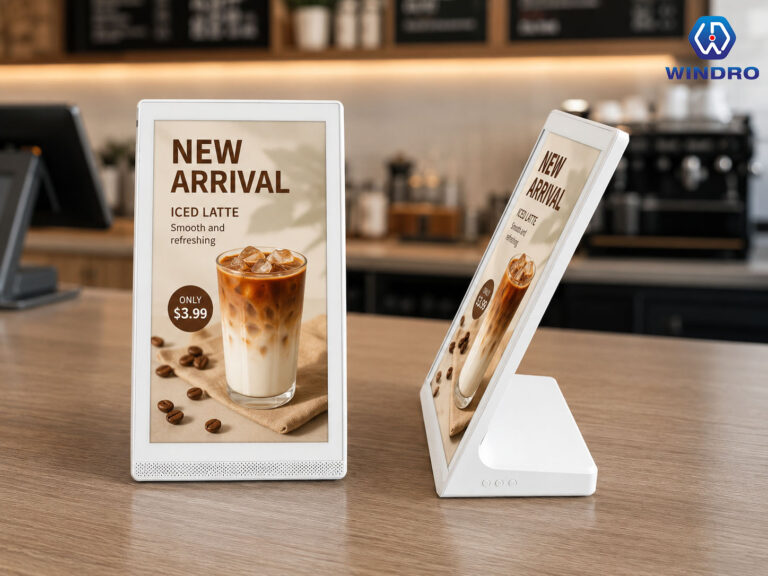
4. L-Shaped Digital Signage for Supermarket Counters
L-shaped digital signage combines a display with an angled stand or support structure, creating a distinctive desktop advertising format.
This design is particularly suitable for checkout counters, customer service desks, promotional tables, and other areas where customers naturally look toward a counter.
Depending on the model, an L-shaped advertising player may feature a touchscreen, Android operating system, Wi-Fi connectivity, or app-based content management.
Practical Applications
Checkout promotions: Display featured products, coupons, and membership offers while customers complete their purchases.
Customer service: Present service information, store announcements, and frequently asked questions.
Product recommendations: Introduce related products or promote seasonal items.
Customer engagement: Use QR codes or compatible interactive applications to encourage customers to learn more about a promotion.
Food counters: Present product images, combo offers, or menu information at prepared-food and bakery counters.
A compact L-shaped digital signage display can complement larger wall-mounted screens by delivering more focused messages at the point of interaction.
For retailers and system integrators, customizable options may include screen dimensions, stand design, branding, hardware platform, and software configuration.
5. Double-Sided Digital Signage for Supermarket Aisles
In supermarkets with open layouts or wide aisles, shoppers may approach an advertising display from different directions.
Double-sided digital signage addresses this challenge by providing two viewing surfaces within one installation.
Depending on the model, both screens can show the same content or display different promotional messages.
Where Does Double-Sided Digital Signage Work Best?
- Aisle intersections
- Store entrances and transition areas
- Promotional islands
- Checkout queues
- Open spaces near service counters
- Retail locations where shoppers approach from multiple directions
For example, a supermarket can promote a beverage campaign on one side and a seasonal snack promotion on the other. Alternatively, both screens can display the same campaign to increase visibility.
Double-sided hanging displays may be suitable for locations with appropriate ceiling structures and sufficient clearance. Other mounting configurations can be selected according to the store layout.
When planning a double-sided installation, check the brightness of each screen, viewing angles, power and signal routing, mounting stability, and maintenance access.
6. Large-Format Digital Signage for Supermarket Promotions
Large-format digital signage is useful when a supermarket wants to make a promotional message visible across a wider area.
Displays in the 32-inch to 75-inch range can be considered for store entrances, promotional zones, feature walls, and selected department areas. The appropriate size depends on viewing distance, available space, and the amount of information being displayed.
Common Applications
Seasonal campaigns: Promote holiday products, summer beverages, or back-to-school items.
Brand advertising: Give suppliers and consumer brands a dedicated space to present their products.
Product launches: Use video and high-resolution imagery to introduce new products.
Department promotions: Highlight featured items in bakery, fresh food, household products, or personal care.
Store announcements: Communicate opening hours, membership benefits, and special events.
A larger screen is most effective when the content is designed for the viewing distance. Short headlines, clear product images, and strong visual contrast are usually easier to understand than dense blocks of text.
For indoor supermarkets, brightness should be selected according to ambient light and installation position. Displays facing bright windows may need higher brightness than screens installed deeper inside the store.
7. Touchscreen Digital Signage for Interactive Shopping Experiences
Touchscreen digital signage gives shoppers the opportunity to interact directly with on-screen content.
Rather than simply watching an advertisement, customers may be able to browse product information, explore categories, find store services, or access other interactive applications.
Potential Supermarket Applications
Product information stations: Provide additional details about selected products.
Store directories: Help customers locate departments or services.
Promotional browsing: Allow shoppers to explore campaigns and featured products.
Customer surveys: Collect feedback through a compatible touchscreen application.
Self-service information: Present service guidance and other frequently requested information.
Touchscreen digital signage requires more than a touch-enabled panel. The software interface must also be designed for the intended use, and the hardware should support the required operating system and applications.
Before deployment, supermarkets should evaluate touch responsiveness, screen durability, ease of cleaning, software compatibility, and the accessibility of the installation.
For public-facing applications, the enclosure and mounting structure should be appropriate for frequent customer interaction.
8. Digital Menu Boards for Supermarket Bakeries and Food Counters
Many supermarkets include bakeries, delis, coffee counters, prepared-food sections, or small dining areas. Digital menu boards can help these departments present product information in a clear and flexible format.
Compared with printed menus, digital menu boards make it easier to change featured items, highlight seasonal products, and update promotional content when supported by the content management workflow.
Useful Features for Digital Menu Displays
- High-resolution product images
- Clear pricing and promotional information
- Scheduled content changes
- Multiple-screen layouts
- Remote publishing through compatible CMS software
- Custom screen sizes for different counter layouts
For example, a supermarket bakery can use a digital menu board to feature fresh bread in the morning and seasonal desserts later in the day. A deli counter can display product categories, meal combinations, and daily specials.
For these applications, the display size and layout should reflect the number of products shown and the distance between the screen and the customer.
9. Stretched Bar Displays for Shelf-Edge Advertising
Although this article covers multiple digital signage formats, stretched bar displays remain useful for supermarket shelving and narrow retail spaces.
Their elongated aspect ratio makes them suitable for promotional content positioned close to products.
Potential applications include product launches, category advertising, brand campaigns, and promotional messages along selected shelves.
Unlike electronic shelf labels, which are primarily designed to show individual product prices, LCD stretched bar displays are intended for more visually engaging content such as product images, animation, and video.
For supermarkets that want to combine shelf-level promotion with broader in-store advertising, stretched bar displays can complement wall-mounted screens, countertop displays, and large-format signage.
Explore the WINDRO Stretched Bar Display range for more information about screen formats and customization options.
10. How to Choose the Right Digital Signage for a Supermarket
With so many display formats available, supermarkets should start by identifying the purpose of each installation.
Consider the Location
A checkout counter may need a compact desktop display, while a store entrance may require a larger screen. Aisle intersections may benefit from double-sided displays, whereas narrow shelf spaces may suit stretched bar screens.
Match the Screen to the Content
Short promotional messages can work well on compact displays. Product videos and larger campaigns may benefit from bigger screens with higher resolution.
Confirm the Hardware and Software
Check operating system options, content playback, CMS compatibility, connectivity, and remote management requirements before selecting a model.
Evaluate Brightness and Viewing Conditions
Consider ambient light, screen reflections, viewing distance, and the position of the display. Brightness should be matched to the real installation environment.
Plan for Installation and Maintenance
Confirm mounting methods, power access, cable routing, ventilation, cleaning requirements, and maintenance access.
Consider Customization
Some projects require non-standard screen dimensions, special mounting structures, customized enclosure colors, logo branding, or specific hardware interfaces.
Working with a manufacturer that supports OEM/ODM services may help retailers and system integrators develop hardware that fits these requirements.
11. Can Supermarkets Manage Multiple Displays Through One CMS?
A digital signage content management system can help retailers manage content across compatible displays and locations.
Depending on the software platform, CMS features may include:
- Centralized content publishing
- Playlist creation and scheduling
- Screen grouping by store or department
- Remote campaign updates
- Device status monitoring
- Multi-screen content management
For example, a supermarket chain could schedule a national promotional campaign across multiple branches while allowing individual stores to display local offers on selected screens.
However, not all displays support the same CMS. Before purchasing, confirm software compatibility, licensing requirements, network configuration, and whether the selected system supports the intended screen groups.
For larger projects, it is useful to test the complete workflow with sample hardware before rolling out the solution across multiple stores.
12. WINDRO Custom Digital Signage Solutions for Supermarkets
WINDRO provides commercial display hardware and OEM/ODM customization for digital signage projects. For supermarket applications, different display formats can be selected according to the installation location, advertising purpose, and technical requirements.
Potential solutions include:
- Wall-mounted advertising players for entrances, aisles, and promotional areas
- Countertop digital signage for checkout counters and customer service desks
- L-shaped advertising displays for compact desktop applications
- Double-sided digital signage for aisles and open retail spaces
- Large-format advertising displays for promotional campaigns and department advertising
- Touchscreen displays for interactive information and customer-facing applications
- Digital menu displays for bakeries, delis, and food counters
- Stretched bar displays for shelf-edge advertising
Depending on the selected model, customization may include screen size, brightness, operating system, mainboard, interfaces, enclosure, stand design, and branding.
WINDRO can work with distributors, retail technology companies, and system integrators to discuss hardware configurations for specific projects. Availability and customization options should be confirmed against the required specifications and order quantity.
If you are planning a supermarket digital signage project, preparing a list of target locations, display sizes, content requirements, and estimated quantities will help determine the most suitable configuration.
Visit www.windro.cn or contact info@windro.cn to discuss your project.
Frequently Asked Questions
What types of digital signage are used in supermarkets?
Common formats include wall-mounted advertising displays, countertop players, L-shaped desktop displays, double-sided screens, large-format promotional displays, touchscreen information displays, digital menu boards, and stretched bar displays.
What is the best digital signage for supermarket checkout counters?
Compact countertop or L-shaped advertising displays are often suitable for checkout counters because they fit into limited spaces and can present promotions, loyalty program information, and QR codes close to customers.
Can supermarkets use wall-mounted Android advertising players?
Yes. Android-based advertising players can be suitable for supermarket promotions when their software, content playback capabilities, and CMS are compatible with the project requirements.
What is the difference between digital signage and electronic shelf labels?
Digital signage generally focuses on advertising, promotional content, images, and video. Electronic shelf labels primarily display product prices and related information. Both can be used in the same supermarket.
Can one CMS manage different types of digital signage?
Potentially, yes. Multiple display types can be managed through one CMS when their hardware, software, and network configurations are compatible. Compatibility should be verified before deployment.
Can digital signage displays be customized for supermarket projects?
Yes. Depending on the manufacturer and model, customization may include screen dimensions, brightness, operating system, interfaces, enclosure design, stand structure, and logo branding. OEM/ODM capabilities are particularly useful for distributors and system integrators.
Conclusion
Digital signage for supermarkets is not a one-size-fits-all solution. Wall-mounted screens can promote campaigns across the store, countertop and L-shaped displays can communicate with shoppers at checkout, double-sided screens can serve open aisles, and touchscreen displays can support interactive experiences.
Large-format displays and digital menu boards can further extend digital communication into promotional areas and food service departments.
By combining the right display formats with compatible content management software, supermarkets can build a flexible digital signage system that supports different departments and customer touchpoints.
For retailers, distributors, and system integrators looking for customizable commercial display hardware, WINDRO offers digital signage solutions for a variety of retail applications.
Contact WINDRO at info@windro.cn or visit https://windro.cn/ to discuss your custom digital signage requirements.