How to Choose a Digital Signage Manufacturer for Retail in 2026
Digital signage has become an important part of modern retail environments. From storefront advertising and shopping malls to supermarkets, restaurants and hotels, digital displays help businesses communicate products, prices, promotions and brand messages in a more flexible way than traditional printed signage.
But choosing the right digital signage manufacturer is not simply about finding a screen with the right size and resolution.
For a retail project, factors such as brightness, operating system, enclosure design, touchscreen capability, installation method, content management, reliability and customization can all affect the final result.
For retailers, advertising companies, system integrators and distributors, working directly with an experienced digital signage manufacturer can also provide greater flexibility when standard products are not enough.
This guide explains the key factors to consider when selecting a digital signage manufacturer for retail projects in 2026.
What Is a Digital Signage Manufacturer?
A digital signage manufacturer develops and produces commercial display hardware designed for advertising, information delivery, interactive applications and digital communication.
A professional digital signage manufacturer may provide more than standard LCD displays. Depending on the project, services can include:
- Commercial display design
- Digital signage hardware
- High-brightness displays
- Touchscreen displays
- Outdoor digital signage
- Interactive kiosks
- Digital menu boards
- Double-sided displays
- Stretched bar displays
- Custom enclosures
- Android, Windows or Linux systems
- Media player integration
- OEM and ODM services
- Custom mounting solutions
For large retail projects, the ability to customize both hardware and structure can be particularly important.
Instead of adapting a project around an existing display, businesses can work with a custom digital signage manufacturer to develop a solution around the actual installation environment.
Why Retail Businesses Need More Than a Standard Commercial Display
A standard consumer TV may look attractive and affordable, but retail digital signage often has very different requirements.
Retail displays may need to operate for long hours every day while dealing with changing lighting conditions, limited installation space and specific mounting requirements.
For example, a storefront display may require high brightness so that content remains visible under strong ambient light. A supermarket shelf may require a long, narrow display rather than a conventional 16:9 screen.
A restaurant may need an interactive touchscreen menu, while a hotel may require a compact tabletop digital signage solution.
This is why retail digital signage is increasingly becoming a customized hardware solution rather than simply a television used for advertising.
7 Things to Check Before Choosing a Digital Signage Manufacturer
1. Display Quality and Brightness
Display quality is one of the first factors to evaluate.
For indoor retail environments, brightness around 500–700 nits can be suitable for many applications. However, storefronts and outdoor environments may require much higher brightness depending on direct sunlight and installation conditions.
When evaluating a high brightness digital signage manufacturer, consider:
- Brightness
- Resolution
- Viewing angle
- Contrast
- Color reproduction
- Panel quality
- Anti-glare options
- Operating temperature
- Expected operating hours
For premium retail applications, 4K UHD displays can provide sharper product images, advertising graphics and promotional videos.
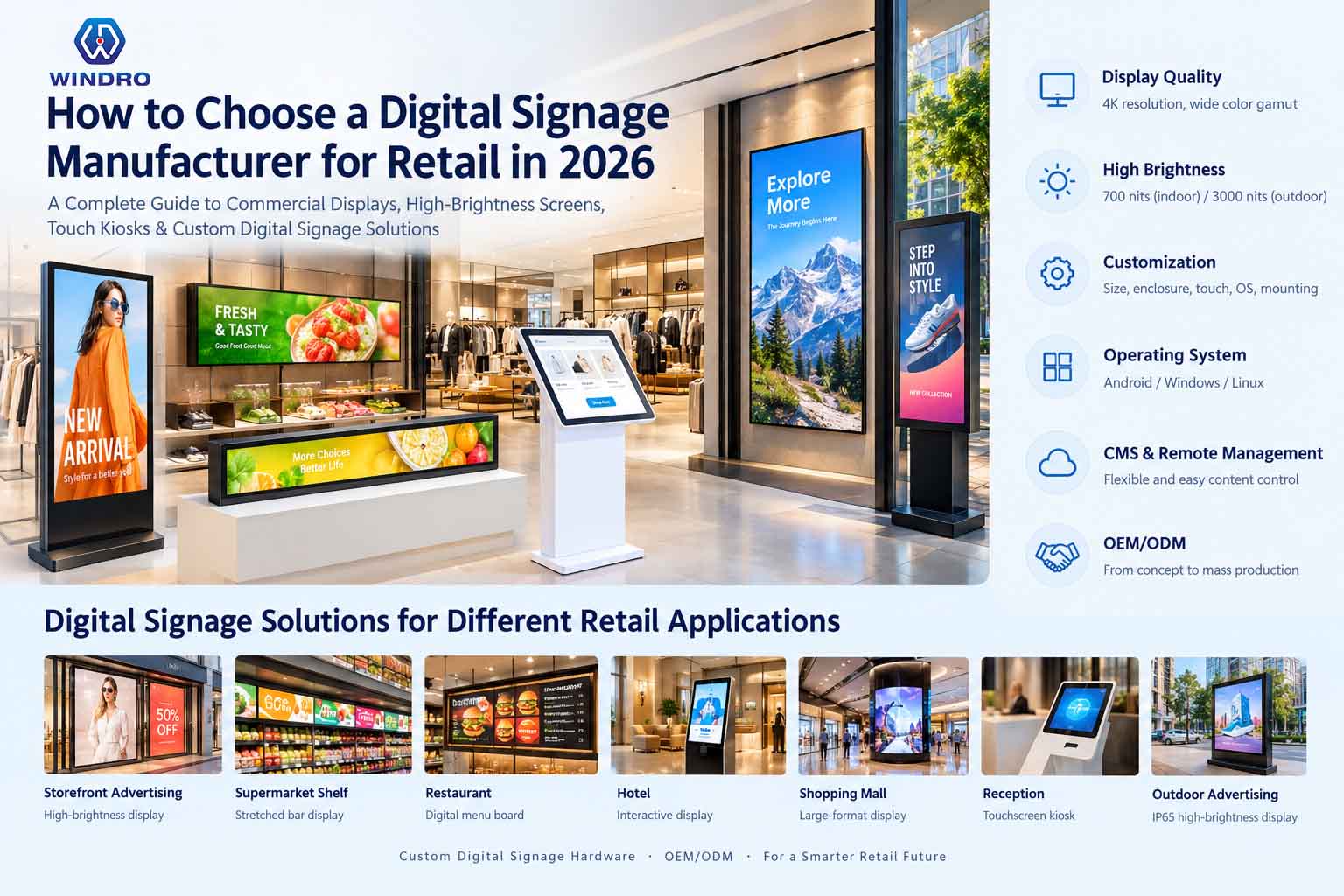
WINDRO provides commercial display solutions with options for 4K resolution, high brightness and wide-color-gamut displays, depending on project requirements.
2. Hardware Customization
Not every retail environment can use the same standard display.
A custom project may require a specific:
- Screen size
- Enclosure
- Bezel
- Mounting structure
- Touchscreen
- Brightness level
- Interface configuration
- Logo
- Operating system
- Installation method
This is where a custom digital signage manufacturer can provide an advantage.
For example, a retail brand may need a display integrated into a wall, a supermarket may require a narrow shelf-edge display, while a hotel may need a customized tabletop advertising screen.
A manufacturer with OEM/ODM capabilities can adapt the hardware to the application instead of forcing the application to fit a standard product.
3. Operating System and Media Player Options
The operating system is another important consideration when choosing a digital signage solution.
Depending on the project, digital signage hardware may use:
- Android
- Windows
- Linux
- Ubuntu
- Dedicated media players
- Raspberry Pi-based systems
Android digital signage can be useful for applications requiring an integrated and flexible platform.
Windows-based systems may be suitable for applications that depend on existing Windows software.
Linux and Ubuntu can be considered for specialized applications requiring an open and customizable operating environment.
A good digital signage supplier should be able to discuss the hardware and software requirements together rather than treating the display as an isolated component.
4. Touchscreen and Interactive Digital Signage
Digital signage is increasingly becoming interactive.
Instead of simply displaying advertising, an interactive display can allow customers to:
- Browse products
- Check product information
- Place orders
- Navigate menus
- Register for services
- Leave reviews
- Find locations
- Interact with promotional content
This creates opportunities for touchscreen digital signage and interactive kiosks in retail stores, restaurants, hotels, exhibitions and public spaces.
When selecting an interactive digital signage manufacturer, check whether the supplier can customize:
- Touch technology
- Screen size
- Touch points
- Protective glass
- Enclosure
- Mounting structure
- Android or Windows platform
For projects requiring a unique appearance or installation method, these customization capabilities can be important.
5. Indoor vs. Outdoor Digital Signage
Indoor and outdoor digital signage have very different technical requirements.
Indoor displays are commonly used in:
- Retail stores
- Shopping malls
- Restaurants
- Hotels
- Offices
- Schools
- Hospitals
Outdoor applications may include:
- Storefront advertising
- Transportation
- Outdoor retail
- Public information
- Events
- Advertising kiosks
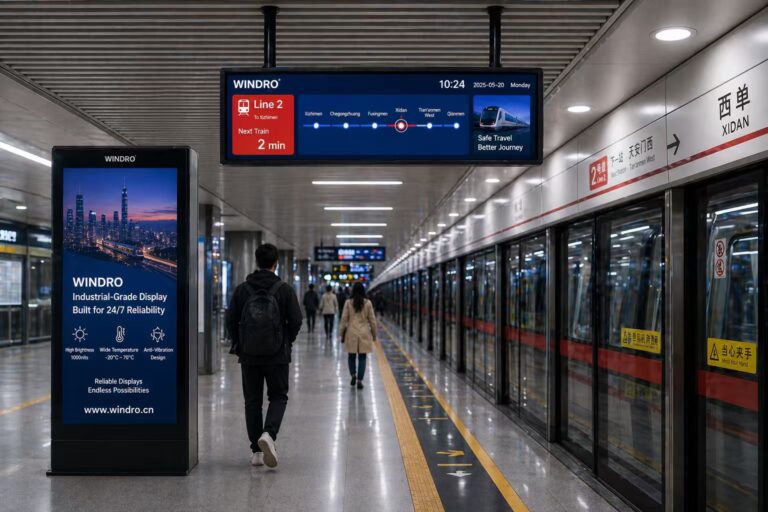
Outdoor digital signage may require higher brightness, stronger protection and greater resistance to environmental conditions.
For outdoor projects, buyers should consider:
- High brightness
- IP protection
- Temperature range
- Anti-glare glass
- Weather resistance
- Cooling design
- Enclosure construction
- Power management
Choosing the right specifications at the beginning can help avoid visibility and reliability problems after installation.
6. CMS and Remote Content Management
A digital signage network is more useful when content can be managed remotely.
A typical digital signage system may include:
Display Hardware → Media Player → Network → CMS → Content
A CMS can allow users to schedule and update content across multiple screens.
For example, a retail company with 50 stores could update promotional content centrally instead of manually replacing content on every display.
When choosing a digital signage manufacturer, ask whether the hardware can work with your preferred CMS or third-party digital signage software.
For some projects, the manufacturer may provide an integrated software solution. For other projects, the hardware may need to support an existing CMS platform selected by the customer.
WINDRO can provide digital signage hardware designed to integrate with different project requirements and third-party CMS solutions.
7. OEM, ODM and Small-Batch Production
For distributors, system integrators and brands, OEM and ODM capability can be an important part of supplier selection.
OEM digital signage typically involves manufacturing products according to the customer’s specifications or branding requirements.
ODM digital signage can involve deeper cooperation in product structure, electronics, appearance and functionality.
This can be useful when a customer needs:
- Custom housing
- Custom logo
- Custom screen size
- Custom motherboard
- Custom ports
- Custom mounting
- Custom brightness
- Custom operating system
- Special installation structure
Small-batch production is also important for companies that need to test a new product before moving to larger production volumes.
For these projects, a digital signage OEM manufacturer with engineering and manufacturing capabilities can provide a more flexible development process.
Digital Signage Solutions for Different Retail Applications
Different retail environments require different display formats.
Storefront Advertising
Storefronts often need bright, high-visibility displays that can attract attention from outside the store.
Recommended solutions may include:
- High-brightness digital signage
- 4K commercial displays
- Window-facing displays
- Outdoor digital signage
Supermarket Shelf Advertising
Traditional 16:9 displays are not always suitable for shelf-edge advertising.
A stretched bar display can provide a long, narrow format that fits directly into supermarket shelving.
These displays can be used for:
- Product advertising
- Pricing
- Promotions
- Brand communication
- Shelf-edge media
WINDRO also provides customized stretched bar display solutions with different sizes, brightness levels, operating systems and installation options.
Restaurants
Restaurants increasingly use digital displays for:
- Digital menu boards
- Promotions
- Self-ordering
- Product advertising
- Queue management
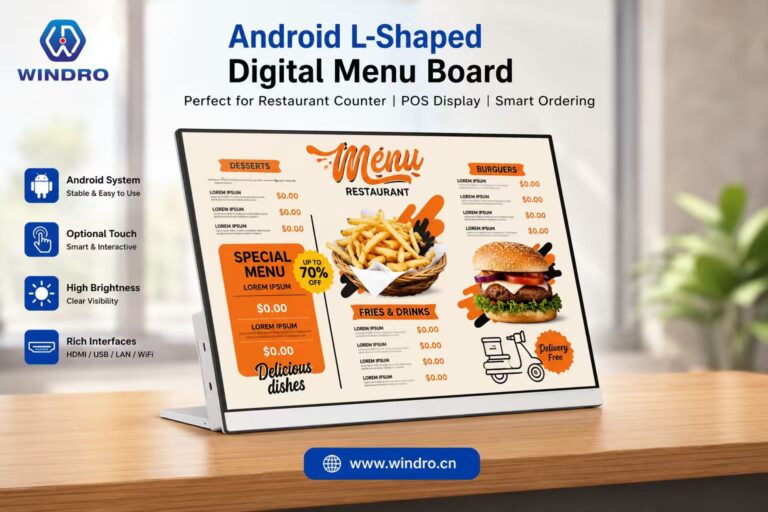
Touchscreen digital signage can also provide interactive ordering functions.
Hotels
Hotels can use digital signage for:
- Lobby advertising
- Event information
- Wayfinding
- Meeting room booking
- Guest information
- Promotional content
Compact tabletop digital signage can also be used at reception desks, restaurants and meeting areas.
Shopping Malls
Large-format commercial displays can be used throughout shopping malls for:
- Brand advertising
- Wayfinding
- Promotional campaigns
- Event information
- Retail media
For large networks, centralized CMS management becomes especially important.
Digital Signage Manufacturer vs. Digital Signage Distributor
When selecting a supplier, it is useful to understand the difference between a manufacturer and a distributor.
A distributor typically sells products manufactured by another company. This can be suitable when standard products are required.
A manufacturer, however, may be able to provide deeper customization and direct engineering support.
| Requirement | Manufacturer | Distributor |
|---|---|---|
| Standard displays | Available | Available |
| Custom enclosure | Depending on manufacturer | Usually limited |
| Custom screen size | Possible | Usually limited |
| OEM branding | Possible | Depends on supplier |
| ODM development | Possible | Usually limited |
| Custom motherboard | Possible | Usually limited |
| Engineering support | Direct | May involve another supplier |
| Small-batch customization | Depending on factory | Depends on supplier |
For projects involving unique hardware requirements, OEM/ODM development or customized installation structures, it is useful to ask whether the company is the actual manufacturer or a reseller.
What Makes a Digital Signage Solution Scalable?
A successful digital signage project should not only work for the first few screens. It should also be able to scale as the business grows.
Before placing an order, consider:
Hardware scalability
Can the manufacturer provide the same platform in multiple screen sizes?
Software compatibility
Can the displays work with the customer’s existing CMS?
Installation scalability
Can the same mounting concept be applied across multiple locations?
Supply capability
Can the supplier support future production orders?
Customization
Can the product be modified when a new application requires additional functions?
These questions become increasingly important when digital signage moves from a single-store installation to a multi-location network.
WINDRO Custom Digital Signage Solutions
WINDRO provides custom digital signage hardware and OEM/ODM solutions for retail, advertising, hospitality, transportation, commercial and other professional applications.
Instead of focusing only on standard displays, WINDRO works with customers on the complete hardware solution, including display selection, enclosure design, mounting structure, operating system and project-specific customization.
WINDRO digital signage solutions can include:
- 4K digital signage displays
- High-brightness digital signage
- Outdoor digital signage
- Touchscreen digital signage
- Double-sided digital signage
- Stretched bar displays
- Tabletop digital signage
- Digital menu displays
- Interactive kiosks
- Custom commercial displays
Depending on the project, customers can specify display size, brightness, resolution, touch function, operating system, enclosure, mounting method and other hardware requirements.
WINDRO also supports small-batch OEM/ODM customization, making it possible for businesses to develop and test customized digital signage products before moving into larger-scale production.
For system integrators and advertising companies, this approach can also help create digital signage hardware around the requirements of a specific project.
Digital Signage Trends to Watch in 2026
The digital signage industry continues to move beyond simple advertising screens.
Several developments are shaping modern digital signage projects.
AI-Powered Content
AI can help businesses create, organize and personalize digital content more efficiently.
Cloud-Based CMS
Cloud-based content management allows businesses to control multiple displays from a centralized platform.
Interactive Displays
Touchscreens are creating more opportunities for customer interaction and self-service.
High-Brightness Displays
As digital signage expands into storefront and outdoor environments, high-brightness commercial displays are becoming increasingly important.
Retail Media
Retailers are using their physical environments as media channels, creating new opportunities for brands to display targeted advertising and promotional content.
Shelf-Edge Digital Displays
Compact formats such as stretched bar displays allow digital content to move closer to the actual product and price information.
These developments mean that the future of digital signage is not simply about making screens larger. It is also about making displays more connected, interactive, customizable and suitable for specific environments.
Frequently Asked Questions About Digital Signage Manufacturers
What is a digital signage manufacturer?
A digital signage manufacturer designs and produces commercial display hardware used for advertising, information, interactive applications and digital communication.
What should I look for in a digital signage supplier?
Consider display quality, brightness, reliability, operating system, customization capabilities, CMS compatibility, OEM/ODM services, production capability and technical support.
Can digital signage be customized?
Yes. Depending on the manufacturer, customization may include screen size, brightness, enclosure, touchscreen, operating system, ports, mounting structure and branding.
What is the difference between digital signage OEM and ODM?
OEM generally focuses on manufacturing products according to customer requirements or branding. ODM can involve deeper product development, including structural, electronic and functional customization.
What brightness is suitable for outdoor digital signage?
The required brightness depends on the installation environment, viewing distance and amount of direct sunlight. Outdoor and storefront applications generally require significantly higher brightness than typical indoor displays.
Can digital signage use Android?
Yes. Android is widely used for digital signage because it can provide an integrated platform for applications, content playback and CMS integration.
Can digital signage work with third-party CMS software?
Many digital signage displays and media players can work with third-party CMS platforms. Compatibility should be confirmed based on the operating system, media player and software requirements.
Can manufacturers support small-batch digital signage projects?
Some manufacturers offer small-batch OEM/ODM production. This can be useful for product testing, pilot projects and customized commercial display applications.
Conclusion
Choosing a digital signage manufacturer for retail requires more than comparing screen prices.
Businesses should evaluate display quality, brightness, customization, operating systems, touchscreen options, CMS compatibility, installation requirements and long-term production capabilities.
For standard projects, an off-the-shelf display may be sufficient. For specialized retail environments, OEM/ODM customization can provide more flexibility.
From 4K commercial displays and high-brightness digital signage to touchscreen kiosks, double-sided displays and stretched bar screens, the right hardware platform should be selected according to the actual application.
WINDRO provides custom digital signage hardware and OEM/ODM solutions for businesses looking for flexible commercial display solutions.
Need a customized digital signage solution for your project?
Contact WINDRO to discuss your screen size, brightness, installation and hardware requirements.
Website: www.windro.cn
Email: info@windro.cn