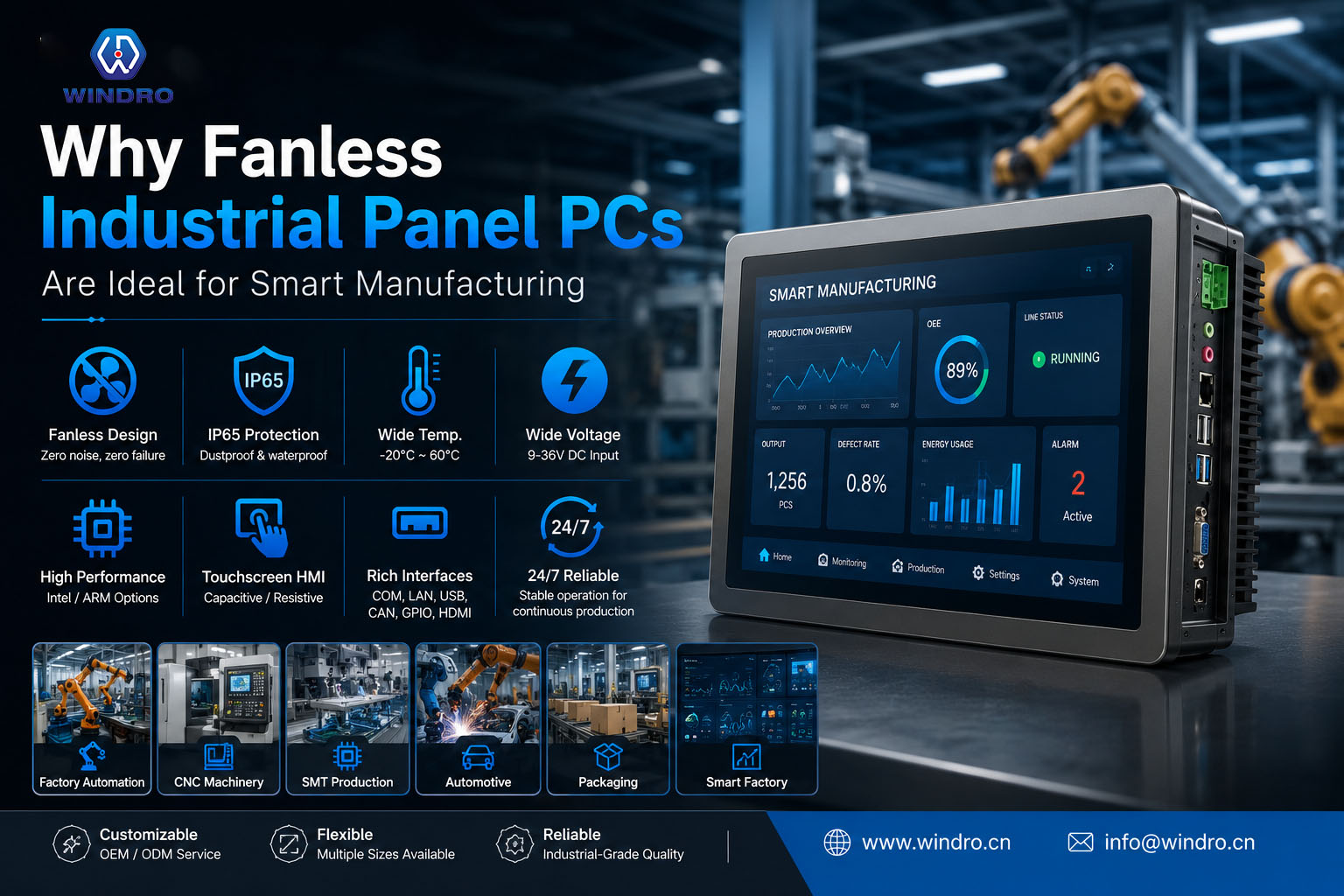
Why Fanless Industrial Panel PCs Are Ideal for Smart Manufacturing
Introduction
Smart manufacturing is transforming modern factories through automation, real-time data collection, industrial IoT, machine vision, MES systems, and intelligent production management. As more machines and production lines become connected, manufacturers need reliable computing devices that can operate continuously in demanding industrial environments.
This is where the fanless industrial panel PC plays an important role.
Unlike conventional commercial computers that often rely on cooling fans, fanless industrial panel PCs use passive thermal management and rugged industrial designs to deliver stable performance with fewer moving parts. Combined with an integrated touchscreen, industrial panel PCs can provide a compact and reliable Human-Machine Interface (HMI) for machines, production lines, and smart factory systems.
For applications such as CNC machines, SMT production, automotive manufacturing, packaging, injection molding, and battery production, a fanless industrial panel PC can provide the reliability, connectivity, and flexibility required for 24/7 operation.
What Is a Fanless Industrial Panel PC?
A fanless industrial panel PC combines an industrial computer, display, and touchscreen into a single integrated device without using a traditional cooling fan.
Instead of relying on active airflow, the computer transfers heat through its industrial enclosure and passive cooling structure.
A typical fanless industrial panel PC may include:
- Industrial-grade aluminum housing
- Passive heat dissipation
- Touchscreen display
- Intel or ARM processors
- Industrial I/O interfaces
- Wide voltage input
- IP65 front protection
- Windows, Linux, Ubuntu, or Android support
- Mounting options for industrial equipment
This integrated design makes fanless industrial panel PCs particularly suitable for smart manufacturing, industrial automation, machine control, and industrial HMI applications.
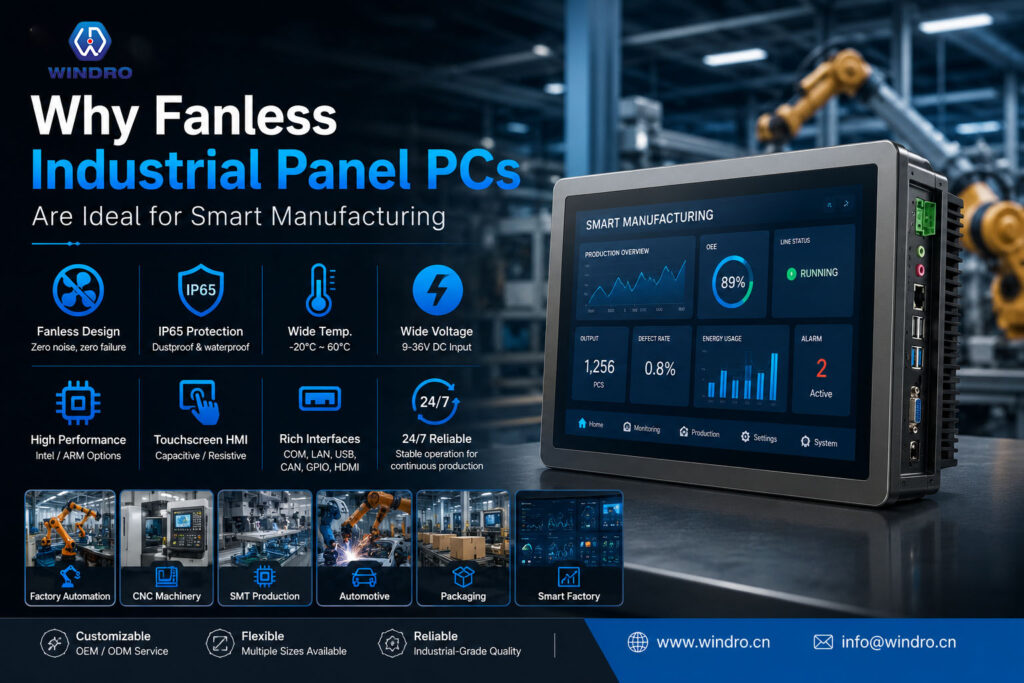
Why Is Fanless Design Important in Smart Manufacturing?
Modern factories are very different from traditional office environments.
Production areas may contain:
- Dust and particles
- Metal debris
- Oil mist
- Vibration
- Heat
- Humidity
- Electromagnetic interference
- Continuous machine operation
A conventional computer designed for an office may not be optimized for these conditions.
A fanless industrial computer eliminates one of the most common moving components in a traditional PC—the cooling fan.
This provides several important advantages.
1. Reduced Dust and Particle Intake
Cooling fans work by moving air through the computer.
In an office environment, this is normally not a major problem. However, industrial environments can contain dust, metal particles, oil mist, and other contaminants.
Over time, contaminants can accumulate inside a fan-cooled computer and affect thermal performance.
A fanless industrial panel PC uses passive cooling instead of continuously pulling air through a fan.
This makes the design particularly suitable for:
- CNC workshops
- Electronics manufacturing
- Packaging production
- Injection molding
- Automated production lines
- Industrial control cabinets
For smart factories where equipment is expected to operate for long periods, reducing unnecessary maintenance can be a major advantage.
2. Fewer Moving Parts for Better Reliability
A cooling fan is a mechanical component.
Mechanical components can eventually wear out.
By removing the cooling fan, a fanless industrial panel PC reduces the number of moving parts in the system.
This can help improve:
- Long-term reliability
- System stability
- Maintenance efficiency
- Continuous operation
For factories running production lines around the clock, reliability is especially important.
A computer failure can interrupt machine operation, delay production, and potentially affect the entire manufacturing process.
That is why fanless industrial computers are commonly considered for 24/7 industrial automation applications.
3. Silent Operation
Fanless cooling also eliminates fan noise.
Although noise may not be a major concern on a large production floor, it can be important in environments such as:
- Industrial control rooms
- Laboratories
- Medical equipment
- Inspection stations
- Electronics manufacturing
- Automated testing systems
The passive cooling design allows the industrial panel PC to operate quietly while still providing the computing performance required by the application.
4. Better Suitability for Harsh Industrial Environments
Smart manufacturing systems often operate under conditions that are very different from ordinary office environments.
An industrial panel PC may need to withstand:
- Temperature changes
- Dust
- Moisture
- Vibration
- Continuous operation
- Industrial power fluctuations
For this reason, industrial panel PCs are generally designed with more robust mechanical structures than standard commercial computers.
WINDRO fanless industrial panel PCs can be configured with rugged aluminum housings and IP65 front protection, providing additional protection for industrial HMI and machine-control applications.
Fanless Industrial Panel PC for Smart Factory Applications
The advantages of fanless industrial computing become especially clear when looking at real manufacturing applications.
1. CNC Machines and Machine Tools
CNC machines require reliable human-machine interfaces for operators to:
- Set machining parameters
- Monitor machine status
- View production data
- Control machine functions
- Display alarms and notifications
An industrial touch panel PC can be integrated directly into the machine or control cabinet.
A fanless design helps reduce concerns associated with dust and metal particles generated during machining.
For CNC applications, useful features may include:
- Touchscreen operation
- RS232/RS485
- LAN
- USB
- Wide voltage input
- Rugged enclosure
- Industrial mounting options
2. Electronics and SMT Production
Electronics manufacturing requires highly organized production processes and real-time data management.
Industrial panel PCs can be used as:
- ESOP terminals
- Workstation reporting terminals
- Production data terminals
- MES interfaces
- Quality inspection terminals
- Production dashboards
In high-density SMT production environments, compact fanless industrial panel PCs can provide a practical interface while minimizing maintenance requirements.
Touchscreen operation can also simplify interaction between operators and manufacturing software.
3. Automotive Manufacturing
Automotive factories contain highly automated production lines involving robots, conveyors, sensors, PLCs, inspection systems, and MES platforms.
Industrial panel PCs can serve as local interfaces for:
- Welding lines
- Assembly lines
- Inspection stations
- Painting systems
- Robot workstations
- Production monitoring
Because many automotive production lines operate continuously, industrial computers need to support reliable long-term operation.
A fanless industrial panel PC can provide a durable HMI platform for these applications.
4. Packaging and Injection Molding
Packaging machines and injection molding equipment require real-time monitoring and operator interaction.
Industrial panel PCs can be connected to PLCs and other control systems to display:
- Production status
- Machine parameters
- Production quantities
- Alarm information
- Maintenance notifications
A touchscreen interface can make machine operation more intuitive while reducing the space required for separate computers and displays.
5. Solar and Battery Manufacturing
The rapid growth of solar energy, lithium battery, and energy storage manufacturing has increased the need for reliable industrial computing systems.
Industrial panel PCs can be used in:
- Battery production lines
- PACK assembly
- Inspection equipment
- Sorting machines
- Coating equipment
- Formation and testing systems
- Production monitoring
These environments may require fanless operation, wide-temperature support, reliable touch interaction, and long-term system availability.
Key Features to Look for in a Fanless Industrial Panel PC
Not every fanless computer is necessarily suitable for industrial applications.
When selecting a fanless industrial panel PC, manufacturers should consider several important specifications.
IP65 Front Protection
An IP65-rated front panel can help protect the touchscreen and front-facing components against dust and water jets.
This is particularly useful for:
- Factory floors
- Food production
- Packaging equipment
- Industrial machinery
- Wet or dusty environments
For industrial applications, it is important to verify exactly which parts of the device are covered by the IP rating.
Wide Voltage Input
Industrial equipment does not always use the same power environment as office computers.
For applications involving machinery, transportation, or energy systems, wide voltage input can provide greater flexibility.
WINDRO offers industrial panel PC configurations supporting 9–36V DC wide voltage input, making them suitable for a variety of industrial equipment and mobile applications.
Industrial Touchscreen
Touch interaction is becoming increasingly important in modern manufacturing.
Depending on the application, manufacturers may choose:
Capacitive Touch
Suitable for:
- Multi-touch applications
- Smooth user interfaces
- Modern HMI systems
Resistive Touch
Suitable for:
- Industrial gloves
- Specific machine-control environments
- Applications requiring pressure-based touch input
The right touch technology should be selected according to the operating environment and user requirements.
Rich Industrial Interfaces
Smart manufacturing requires communication between computers, machines, sensors, PLCs, and other industrial equipment.
Therefore, a good industrial panel PC should provide appropriate connectivity options.
Common interfaces include:
- RS232
- RS485
- USB
- LAN
- HDMI
- DisplayPort
- CAN
- GPIO
The exact interface configuration should be selected according to the customer’s automation architecture.
Fanless Industrial Panel PC vs Fan-Cooled PC
| Feature | Fanless Industrial Panel PC | Fan-Cooled PC |
|---|---|---|
| Cooling | Passive cooling | Active fan cooling |
| Moving parts | Fewer | More |
| Dust intake | Reduced | Higher potential intake |
| Noise | Very low | Fan noise |
| Maintenance | Low | Potentially higher |
| Industrial HMI | Excellent | Application dependent |
| 24/7 operation | Suitable with proper configuration | Model dependent |
| Harsh environments | Designed for industrial use | Often designed for general use |
The important point is that fanless does not automatically mean industrial.
A truly industrial panel PC should combine fanless cooling with appropriate mechanical design, industrial components, thermal management, connectivity, and environmental protection.
Why Choose WINDRO Fanless Industrial Panel PCs?
WINDRO develops industrial computing and display solutions for manufacturers, automation companies, system integrators, and equipment builders.
WINDRO fanless industrial panel PC solutions can be configured with:
- Rugged aluminum housing
- Fanless thermal design
- IP65 front protection
- 9–36V wide voltage input
- Capacitive or resistive touchscreen
- Intel and ARM processor platforms
- Windows, Linux, Ubuntu, and Android support
- RS232, RS485, USB, LAN and other industrial interfaces
- Different screen sizes
- OEM and ODM customization
This flexibility allows the industrial panel PC to be adapted to different machines, control cabinets, production lines, and smart manufacturing systems.
For equipment manufacturers, customization can include screen size, processor platform, memory and storage configuration, touch technology, I/O interfaces, mounting structure, enclosure design, and branding.
How to Choose the Right Fanless Industrial Panel PC
Before selecting a model, it is important to define the actual application requirements.
Consider these questions:
1. What environment will the panel PC operate in?
Determine whether the system will be exposed to dust, water, oil, vibration, heat, or cold.
2. What screen size is required?
Choose the display size according to viewing distance, available installation space, and application interface.
3. What processor performance is needed?
Simple HMI applications may require less computing power, while machine vision, edge computing, and advanced industrial software may require a more powerful processor.
4. Which operating system will be used?
Common choices include:
- Windows
- Linux
- Ubuntu
- Android
5. Which interfaces are required?
Check whether the system needs:
- RS232
- RS485
- CAN
- USB
- LAN
- HDMI
- GPIO
6. Does the project require customization?
For OEM equipment and system integration projects, customized mounting structures, interfaces, dimensions, or branding may be required.
The Future of Fanless Industrial Computing
As factories become increasingly connected, the role of industrial computers will continue to expand.
Future smart manufacturing systems will increasingly combine:
- Industrial IoT
- Edge computing
- Artificial intelligence
- Machine vision
- MES
- Digital twins
- Real-time production analytics
These applications require computing platforms that can operate reliably close to machines and production processes.
The fanless industrial panel PC is well positioned for this evolution because it combines computing power, touchscreen interaction, industrial connectivity, and rugged mechanical design in a compact form factor.
Conclusion
A fanless industrial panel PC is more than a computer without a cooling fan.
For smart manufacturing, it represents a combination of reliable computing, passive thermal management, industrial protection, touchscreen interaction, and flexible connectivity.
From CNC machines and SMT production lines to automotive manufacturing, battery production, packaging equipment, and smart factory systems, fanless industrial panel PCs can provide a reliable interface between people, machines, and industrial software.
For companies looking for a customized fanless industrial panel PC manufacturer, WINDRO provides OEM and ODM solutions designed around specific industrial applications.
WINDRO — Reliable Industrial Computing Solutions for Smart Manufacturing.
Frequently Asked Questions
What is a fanless industrial panel PC?
A fanless industrial panel PC is an integrated computer and touchscreen designed for industrial environments. It uses passive cooling instead of a conventional cooling fan and is commonly used for HMI, automation, machine control, and smart manufacturing applications.
Why are fanless industrial panel PCs suitable for factories?
Fanless industrial panel PCs have fewer moving parts and do not require a cooling fan to continuously draw air into the system. This can help reduce dust intake, maintenance requirements, and operating noise in suitable industrial environments.
Are fanless industrial panel PCs suitable for 24/7 operation?
Yes. Industrial panel PCs can be designed for continuous 24/7 operation, provided the processor, thermal design, power supply, and environmental specifications are appropriate for the application.
What is the difference between a fanless industrial PC and a regular PC?
A fanless industrial PC is designed around industrial requirements such as passive cooling, rugged mechanical construction, long-term operation, industrial I/O, and environmental resistance. A regular commercial PC is generally designed for standard office or consumer environments.
Does WINDRO provide customized fanless industrial panel PCs?
Yes. WINDRO supports OEM and ODM customization for industrial panel PC projects, including display size, processor platform, touchscreen, I/O interfaces, enclosure design, mounting structure, operating system, and branding.
Can a fanless industrial panel PC support Windows and Linux?
Yes. Depending on the hardware configuration, industrial panel PCs can support operating systems such as Windows, Linux, Ubuntu, and Android.
What voltage does a WINDRO industrial panel PC support?
Selected WINDRO industrial panel PC configurations support 9–36V DC wide voltage input, which can be useful for industrial machinery, transportation, energy, and other applications with variable DC power requirements.